

Traveling overseas gets easier when one compact charger handles unfamiliar wall outlets and several devices. The best travel adapter for most U.S. travelers combines broad plug coverage, USB-C charging, and sensible safety features. Your ideal choice still depends on your destinations, devices, and laptop charging needs.
Quick answer: For most U.S. travelers, the Epicka TA-105 Max is the strongest all-around choice. It combines 75W charging, multiple USB ports, and coverage across 200-plus countries and regions. Budget travelers can choose the Epicka TA-105+, while light packers may prefer Anker’s slimmer Nano model.
Best Picks at a Glance
| Pick | Best for | USB power | Main advantage | Approx. price* |
|---|---|---|---|---|
| Epicka TA-105 Max | Best overall | 75W | Strong balance of power and coverage | \$59.99 |
| Ceptics GaN 100W | Laptop users | Up to 100W class | High-output charging and retractable cable | About \$45 |
| Epicka TA-105+ | Budget travelers | 28W | Six-port design at a low price | \$19.99 |
| Anker Nano | Light packing | 20W | Slim, light body | \$25.99 |
| Ceptics World Travel Adapter Kit 2 | Multiple devices | Up to 55W USB | Two AC outlets and several ports | About \$50 |
| Epicka Air 65W | Business trips | 65W | Lightweight design with laptop-friendly power | \$39.99 |
| Epicka Pulse Duo 140W | Power users | 140W | High output for demanding charging setups | \$119.99 |
*Prices can change by retailer and promotion. Check the current price before purchasing.
How We Chose These Picks
Current travel-accessory reviews consistently reward broad outlet coverage, multiple ports, manageable size, and reliable USB-C charging. Recent guides from WIRED and Travel + Leisure also place Epicka and Ceptics models among their strongest choices. Those priorities make sense for U.S. travelers carrying phones, tablets, watches, cameras, or laptops.
We gave extra weight to USB-C because modern devices increasingly depend on it. We also favored models that reduce the number of separate chargers you need to pack. If you’re organizing the rest of your travel technology, Techanta’s digital tools guide includes useful trip-planning and travel-efficiency ideas.
1. Epicka TA-105 Max: Best Overall
The Epicka TA-105 Max is our top recommendation for travelers who want one capable unit. Epicka lists 75W maximum charging, three USB-C ports, two USB-A ports, and one universal AC outlet. Its built-in plug system covers more than 200 countries and regions.
The 75W output provides enough power for many USB-C laptops and smaller electronics. It also avoids the limited USB speeds found on older universal models. At about \$59.99, it costs more than basic choices but offers greater charging flexibility.
Pros
* 75W maximum charging * Three USB-C ports * Two USB-A ports * Coverage across 200-plus countries and regions * Useful for phones, tablets, and many laptops
Cons
* Heavier than minimalist models * More expensive than basic plug-only options * It does not convert voltage
2. Ceptics GaN 100W: Best for Laptop Users
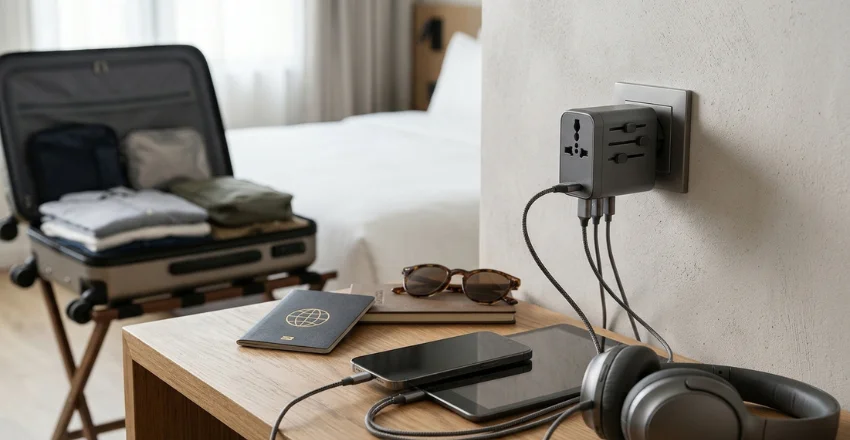
Ceptics is a strong option when higher charging power matters more than minimum weight. WIRED’s September 2026 guide selected a Ceptics GaN model as its overall favorite. Its design includes broad international plug support and a retractable USB-C cable.
The built-in cable can reduce clutter inside a laptop bag or carry-on. Higher available output also suits travelers carrying notebooks and other USB-C equipment. Confirm the specific port allocation before buying because output can vary between Ceptics models.
Pros
* High charging capacity * Retractable USB-C cable * Broad international coverage * Good fit for laptop-heavy trips
Cons
* Bulkier than compact models * Large connected plugs may block nearby sockets * No voltage conversion
3. Epicka TA-105+: Best Budget Choice
You don’t need premium charging speeds for every international trip. The Epicka TA-105+ costs about \$19.99 and provides 28W total DC output. It includes three USB-C ports, two USB-A ports, and a universal AC outlet.
That combination works well for phones, earbuds, watches, and slower-charging tablets. It becomes less attractive when you need rapid laptop charging. For tablet shoppers, Techanta’s tablet buying guide explains why battery life and portability matter on the go.
Pros
* Low purchase price * Six-port design * Multiple USB-C connections * Broad destination coverage
Cons
* 28W maximum output * Not ideal for fast laptop charging * No voltage conversion
4. Anker Nano: Best for Light Packing
The Anker Nano suits travelers who value size over maximum wattage. Anker lists dimensions of 3.39 by 1.97 by 0.98 inches and a 3.77-ounce weight. It provides one AC outlet, two USB-C ports, and two USB-A ports.
Its main USB-C port delivers up to 20W when used alone. Several USB connections share less total output, so this isn’t a laptop-focused charger. The compact shape still makes it attractive for vacations centered on a phone, watch, and earbuds.
Pros
* Compact and lightweight * Five-device capacity * Two USB-C ports * Familiar Anker design
Cons
* Only 20W maximum USB-C output * Multi-port charging reduces shared output * Limited for larger laptops
5. Ceptics World Travel Adapter Kit 2: Best for Many Devices
Travel groups often need more AC outlets rather than maximum charging speed. The Ceptics World Travel Adapter Kit 2 provides two grounded U.S.-style AC outlets. WIRED also reports multiple USB connections and an included USB-C cable.
Its modular components take more bag space than a simple slider design. That tradeoff may be worthwhile for couples or business travelers carrying several chargers. It is also useful when hotel rooms provide fewer accessible wall outlets.
Pros
* Two AC outlets * Multiple USB connections * Useful for several devices * Broad plug selection
Cons
* Larger than all-in-one alternatives * Separate pieces are easier to misplace * Not a voltage converter
6. Epicka Air 65W: Best for Business Trips
The Epicka Air 65W targets travelers wanting useful power without a large body. Epicka lists a weight of about 4.94 ounces and a maximum 65W output. It includes three USB-C ports and one USB-A connection.
That specification creates a useful middle ground between small phone chargers and larger high-output models. It can suit a phone, tablet, and compatible laptop during a short work trip. Its slimmer format also fits crowded tech organizers more easily.
Pros
* 65W maximum output * Three USB-C ports * About 4.94 ounces * Strong balance of portability and power
Cons
* One main AC outlet * More expensive than basic models * Device voltage still requires checking
7. Epicka Pulse Duo 140W: Best for Power Users
The Pulse Duo 140W is aimed at travelers carrying demanding USB-C equipment. Epicka lists 140W maximum power, three USB-C ports, one USB-A port, and two AC outlets. It also covers more than 200 countries and regions through built-in plug types.
Most vacationers do not need this much charging capacity. Video creators, photographers, and professionals with powerful laptops may appreciate the extra headroom. The \$119.99 price makes more sense when it replaces several separate chargers.
Pros
* Up to 140W output * Two AC outlets * Multiple USB-C ports * Strong option for demanding equipment
Cons
* High price * Heavier than simpler choices * Excessive for basic phone charging
Best Travel Adapter Features to Check Before Buying
Start with the countries you expect to visit. Common universal models usually include Type A, C, G, and I output plugs. These cover many destinations across North America, Europe, the United Kingdom, Asia, and Oceania.
Coverage claims still deserve closer inspection before departure. Some universal units do not support every outlet used in countries such as India or South Africa. Checking your destination’s exact plug standard prevents an unpleasant surprise when you land.
Next, consider your highest-power device, not your smallest. A 20W charger may handle a phone perfectly but fall short for a USB-C laptop. Travelers carrying notebooks should consider 65W, 75W, 100W, or higher options when their computer supports those levels.
Port selection also matters on trips with several electronics. Two or three USB-C connections are increasingly useful as newer devices move away from USB-A. Older accessories can still make one or two USB-A ports worthwhile.
Travel Adapter vs. Voltage Converter
A plug adapter changes the physical connection between your device and the wall outlet. A voltage converter changes electrical voltage to a level your equipment can accept. These functions differ, and buying the wrong product can cause serious problems.
Many phone, tablet, and laptop chargers accept an input range around 100–240 volts. Check the printed input information on your own charger before connecting it abroad. Never assume that an unfamiliar appliance supports the local voltage.
High-wattage products deserve particular care. Hair dryers, curling irons, kettles, and similar appliances can require far more power than ordinary electronics. Use equipment specifically rated for the destination voltage or an appropriate converter.
Are Universal Adapters Safe for Phones and Laptops?
A quality model used within its published electrical limits can be appropriate for compatible electronics. Still check both device voltage support and the charger’s maximum output. Avoid damaged units, loose sockets, and unknown products with unclear specifications.
Heat is another useful warning sign during charging. Disconnect equipment if a charger becomes unusually hot, smells abnormal, or shows visible damage. Safety guidance also recommends using reliable chargers and being careful around public charging stations.
Which Option Should You Buy?
Choose the Epicka TA-105 Max if you want the strongest balance for typical international travel. Its 75W output and large port selection handle more situations than basic models. It is our recommendation for travelers wanting one reusable option for future trips.
Choose Anker Nano when every ounce matters and your equipment has modest charging needs. Pick the Epicka TA-105+ when price matters more than charging speed. Laptop users should consider higher-output Ceptics or Epicka models instead.
The Pulse Duo 140W makes sense for demanding professional setups. Most people can save money and luggage space with a 65W or 75W choice. Match power to the devices you already own rather than buying the largest number available.
Frequently Asked Questions
What is the best travel adapter for U.S. travelers?
The Epicka TA-105 Max is our strongest all-around pick for most U.S. travelers. It combines 75W charging with several USB connections and broad international plug coverage. Travelers with simpler charging needs can save money with a lower-output model.
Do I need a voltage converter in Europe?
You need a converter only when your device cannot accept the local voltage. Many modern phone and laptop chargers accept 100–240V input, but you must check your specific charger. A plug adapter alone does not change voltage.
Can I use a U.S. laptop charger overseas?
Many modern laptop chargers support worldwide input voltage, but this isn’t guaranteed. Read the charger’s input label before connecting it to an overseas outlet. You may still need the correct plug shape for the destination.
Is USB-C important on an international charger?
USB-C matters because many current phones, tablets, laptops, and accessories use that connector. Higher-output USB-C ports can also charge compatible laptops without a separate power brick. Check wattage, because USB-C doesn’t guarantee laptop-level power.
Can I carry an adapter on a plane?
Ordinary plug adapters are commonly packed in carry-on luggage with other charging accessories. Airline battery restrictions usually focus more closely on power banks and spare lithium batteries. Check your airline’s current rules when your charging product contains a battery.
Final Verdict
For most U.S. travelers, the Epicka TA-105 Max offers the most useful combination of charging power, ports, and international coverage. The Anker Nano is better for minimalist packing, while the Epicka TA-105+ offers strong value. Higher-output Ceptics and Epicka models make more sense when a laptop is central to your trip.
Check your destinations and every device’s voltage rating before leaving home. Then choose enough USB-C power for the largest device you expect to charge. That simple check can prevent carrying unnecessary chargers or arriving with equipment you cannot safely use.