
Studies reveal that a staggering 70% of digital transformation projects fail, according to research by Boston Consulting Group and McKinsey[[i]].
Moreover, Info-Tech Research Group[[ii]] highlights that 70% of these failures stem from issues related to requirements. Combining these statistics suggests that nearly 49% of digital transformation projects collapse due to poor requirements—almost half! Additionally, Tecnova[[iii]] reports that 80% of project rework can be traced back to inadequate requirements gathering.
A notable example is the NHS’s scrapped £11 billion system[[iv]], intended to be the world’s largest unified civilian system connecting every part of the NHS. The project was terminated due to failures rooted in poorly defined requirements during the project’s early stages.
Despite such alarming data, 70% of organizations still fail to take effective measures to improve the quality of their requirements (Tecnova). Given that requirements gathering is a primary pitfall in software development—costing the industry millions annually—this area remains critically neglected.
Software requirements often seem to be the ‘poor relation’ in the development process, both undervalued and under-taught within the developer community. The statistics above confirm that the quality of requirements remains a significant challenge in software development.
The widespread adoption and frequent misuse of Agile methodologies further reflect this issue. Many organizations using Agile avoid defining detailed upfront requirements, opting instead to develop requirements progressively as the project advances. While this approach has benefits, it complicates fixed-budget planning and may lead to reduced features if the project overruns its budget.
Our own research sheds light on how requirements receive less credibility than other areas of software development. While significant focus is placed on technology and execution, the fundamental question of “what are we building?” often doesn’t get enough attention.
University Coverage
The minimal emphasis on requirements gathering can often be traced back to inadequate coverage in university curricula.
Within our company, numerous developers have confirmed that requirements gathering received minimal or no attention during their university education. Feedback from developers across various universities and cohorts consistently highlights that while tools like UML, ERD diagrams, and user stories were covered, comprehensive requirements gathering strategies needed for real-world commercial software development were largely absent. Instead, the focus tended to be on object-oriented programming (OOP) concepts, databases, and programming languages like Java and C#. Although these subjects are critical, they are insufficient without fully defined requirements to drive effective software design and delivery.
For example, an analysis of the curriculum from a top 10 UK university for Computer Science degrees showed that out of approximately twenty courses taken by software engineering students over four years, only two explicitly mentioned requirements gathering. Within these, perhaps only a quarter of the content related specifically to requirements. This means as little as 2.5% of the entire software engineering degree focuses on requirements gathering, echoing the experiences of our interviewed developers.
Similarly, Scottish universities and commercial software engineering bootcamps show comparable trends, with limited emphasis on thorough requirements gathering. Considering that requirements are the foundation of all digital projects and have a proven link to project success or failure, it is concerning this skill is overlooked in education. Unlike programming languages that vary by project, effective requirements gathering remains universally essential.
Lack of Literature
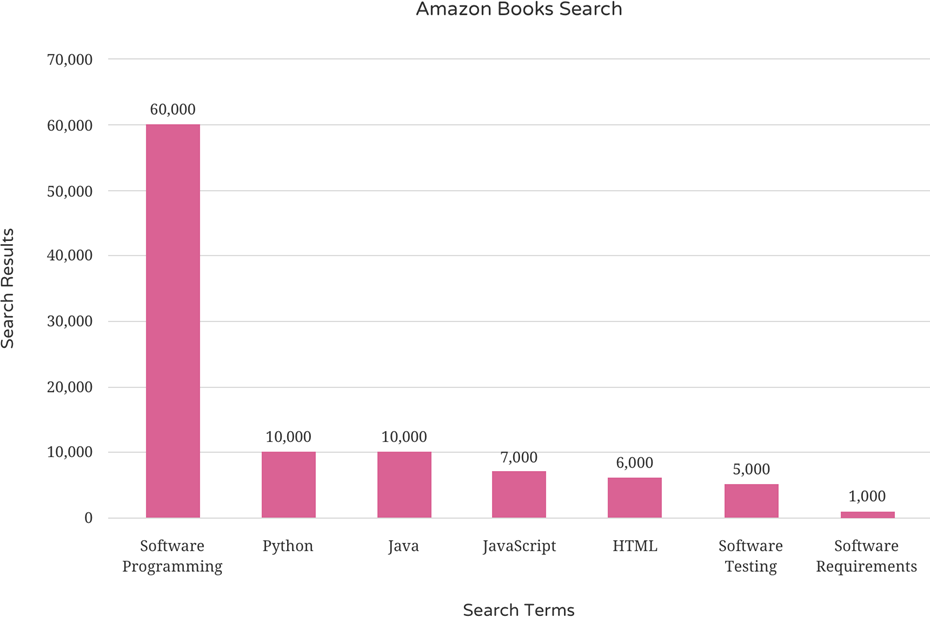
Looking beyond academics, the scarcity of literature on requirements gathering further exemplifies this neglect within the software engineering community. The graph above shows the number of books available on Amazon for various software engineering topics. Software requirements have significantly fewer books compared to other areas. For instance, a single programming language—of which there are many—has roughly ten times more books dedicated to it than requirements gathering.
This lack of literature corresponds with the poor coverage in education and highlights a broader industry-wide gap in resources supporting proper requirements practices.
Google Search Results
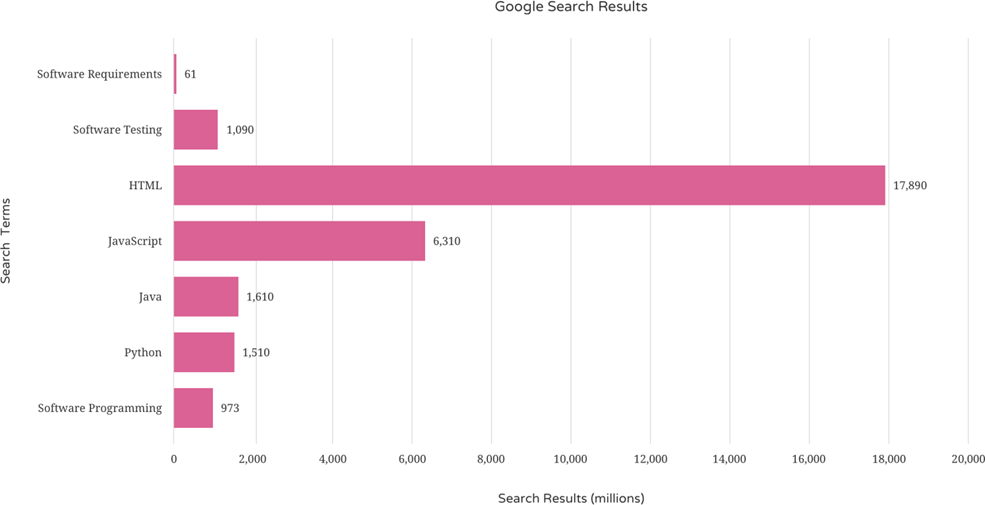
The pattern continues when examining online content. The above graph demonstrates significantly fewer Google search results for topics related to software requirements when compared to other software development subjects. This indicates a general scarcity of available information on requirements gathering online, possibly due to the limited formal education and underappreciation of its importance.
Conclusion
In summary, both education and available literature consistently overlook requirements gathering—the most critical phase of software development. This neglect likely contributes to the poor quality of requirements and the high failure rate of digital projects worldwide.
Requirements gathering is an often under-valued skill, yet it plays a pivotal role in project success. Projects succeed when there is a full, detailed, and structured understanding of what the system is supposed to do from the outset. Starting projects with thorough requirements gathering minimizes rework, controls budgets, and aligns stakeholder expectations.
Our requirements gathering software guides users through a comprehensive set of prepared questions to define detailed requirement specifications and project scope based on outcomes. It acts as a virtual business analyst, providing insights and recommendations tailored to the application being developed and the latest industry trends. Our mission with Requiment is to make software requirements capture more accurate, agile, and efficient—ultimately leading to more successful software projects.
Frequently Asked Questions (FAQs)
Approximately 70% of digital transformation projects fail, with nearly half attributable to poor requirements gathering. Inadequate or unclear requirements often cause scope creep, miscommunication, and misaligned expectations, leading to project failure.
Requirements gathering defines what the software should achieve. Without clear, detailed, and accurate requirements, developers may build the wrong solution, leading to rework, increased costs, and missed deadlines.
University curricula often prioritize programming languages, algorithms, and software design over the process of eliciting and managing software requirements. This results in graduates lacking critical skills to gather and define requirements effectively.
Agile promotes iterative development and flexibility in requirements. While this can enhance adaptability, it may also lead to insufficient upfront requirements definition, complicating budget and timeline management.
Organizations should invest in training for requirements elicitation techniques, use structured processes and tools like Our requirements gathering software, and engage stakeholders early and frequently to ensure clear, agreed-upon requirements before development.